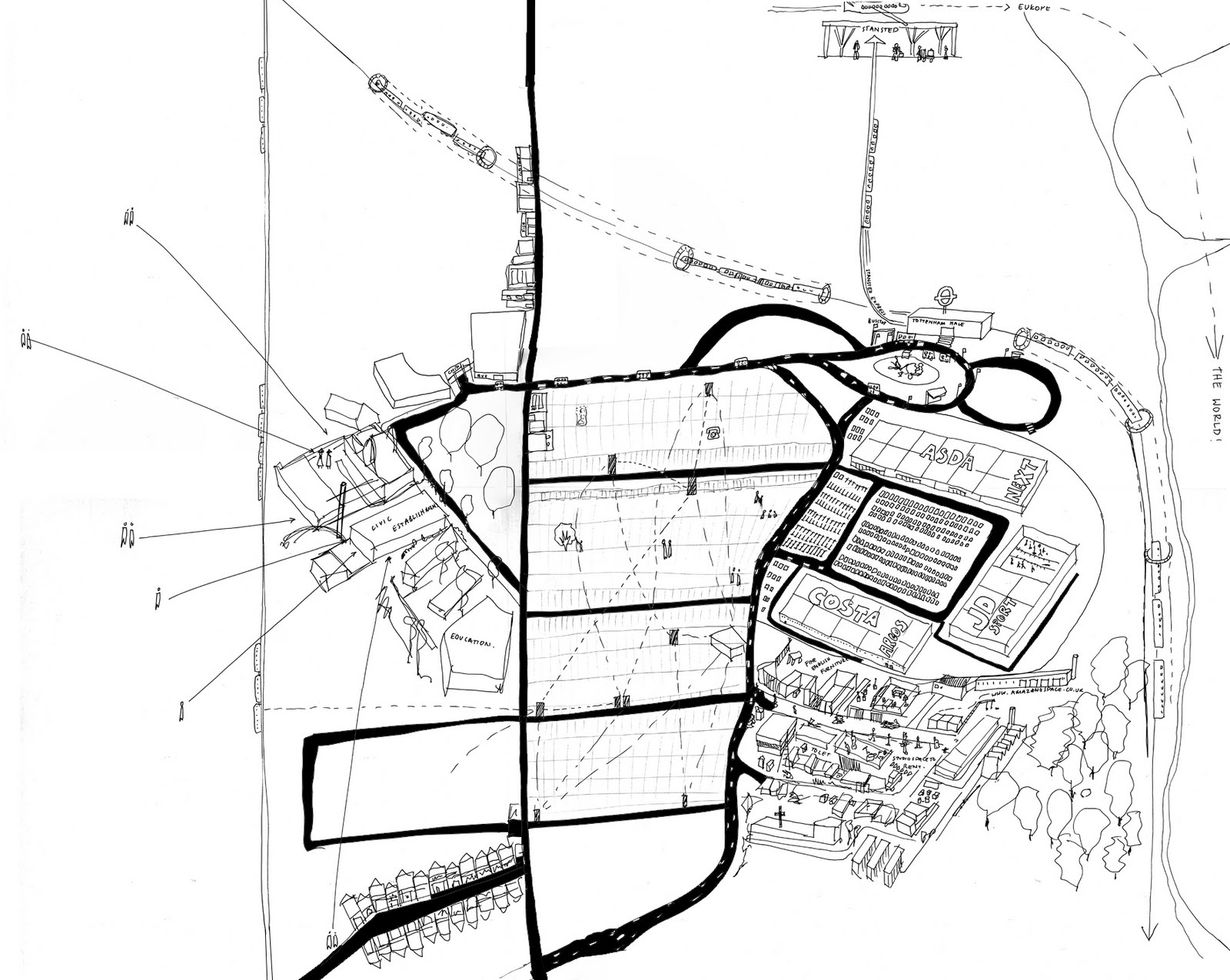
I have recently started field work in Tottenham, walking along the high road and drawing it, talking to people, and trying to find ways in to the place and its people. Ultimately, I am intending conduct some focus groups and interviews (all very spatial, of course) to begin to uncover what the high street means to people, what role it plays in their lives.
But how does one go about 'meeting people'? Such a simple phrase, so difficult to actually achieve. Of course, you meet people when you walk into a shop, you can converse with people at bus stops - but they are very brief, fleeting exchanges, Also, particularly in shops when one is, say, buying a chocolate bar, the interaction is very scripted, almost pr-ordained. It is not done to make in-depth conversation with a shopkeeper about the nature of the high street; people behind in the queue start to get huffy; and most shopkeepers (apart from the odd particularly friendly and verbose one) do not really want to have a long conversation with someone they do not know, they save their sociable chat for people they see regularly, or have some other connection with outside the customer/shopkeeper relationship.
So, I have done several things. First, I started eating in cafes, staying for one hour and observing what happened while I was there; who came in and out, who spoke to whom. I also attempted, futilely, to chat to people; but the decorum attached to adjacent tables is such that one simply does not lean across and make conversation with one's neighbour, and everyone would look at you askance if you join someone else's table if there are tables free.

Second, I have transferred the usual salon treatments I have (leg waxing, eyebrow threading) to Tottenham High Road. I said to myself, as I walked along the high road, that I would walk into the FIRST place I saw which offered eyebrow threading. However, an interesting this happened: I discovered that I was less keen to enter some beauty establishments than others. The first place I passed had only four women inside, and all seemed deeply engaged in conversation with one another. I was too shy to enter, fearful that I would be intruding on their conversation, and I couldn't pluck up the courage. This salon is shown here:

So, I proceeded until I found a place which was more similar to salons where I have been before. This one was staffed with a mix of women, and was much bigger. No-one appeared to be having a private conversation. The women who did my eyebrows was Turkish, and extremely friendly. I was not shy of this woman because I have been to Turkey on several occasions, and have met many Turkish people.

I have learned two things from this initial foray into Tottenham. First, that the parallel communities are stark, especially in hairdressing/beauty salons. As you pass by, you look in, and everyone looks like they are of the same ethnic origin, wearing similar clothes, and like they know one another. This seems to be less so with nail salons, which appear to have more of a mix of people.
The second thing I have uncovered is the relationship between the setting, and the people, and the likelihood that I will enter a particular high street establishment. It is previous experience of a similar setting which seems to be the most pertinent aspect of my decision, rather than necessarily the people inside. For example, I am very happy to enter a shop which sells beauty and hair products for black women, even though I myself am white, because I always used to use such as a teenager to buy colourful hair extensions. However, I am reluctant to enter a nail parlour, because I have never had my nails one professionally before. This seems to have something to do with the topic of the setting, ie. I have had my legs waxed before, and there are certain procedures which leg waxing involves, which do not change - regardless of the place the waxing happens (for example, I had my legs waxed in Seven Sisters by a woman whose English was very difficult for me to understand; but it didn't matter because we both knew what was happening and we both adhered to the unwritten leg-waxing code. In contrast, the nail parlour is a mystery to me; I am disconcerted by not knowing the unwritten nail-code, or any of the language (for example, I do not know what a set of acrylics is, really, how they're attached, or how much they should cost).
It is interesting to wonder to what extent these types of feelings are universal amongst people and what factors persuade them to overcome their fear and enter unfamiliar setting. I wonder if thus says something about why the high street chains have such an enduring popularity; they are eminently predictable in their context, the staff are predictable, and the experience does not vary from place to place.

But how does one go about 'meeting people'? Such a simple phrase, so difficult to actually achieve. Of course, you meet people when you walk into a shop, you can converse with people at bus stops - but they are very brief, fleeting exchanges, Also, particularly in shops when one is, say, buying a chocolate bar, the interaction is very scripted, almost pr-ordained. It is not done to make in-depth conversation with a shopkeeper about the nature of the high street; people behind in the queue start to get huffy; and most shopkeepers (apart from the odd particularly friendly and verbose one) do not really want to have a long conversation with someone they do not know, they save their sociable chat for people they see regularly, or have some other connection with outside the customer/shopkeeper relationship.
So, I have done several things. First, I started eating in cafes, staying for one hour and observing what happened while I was there; who came in and out, who spoke to whom. I also attempted, futilely, to chat to people; but the decorum attached to adjacent tables is such that one simply does not lean across and make conversation with one's neighbour, and everyone would look at you askance if you join someone else's table if there are tables free.

Second, I have transferred the usual salon treatments I have (leg waxing, eyebrow threading) to Tottenham High Road. I said to myself, as I walked along the high road, that I would walk into the FIRST place I saw which offered eyebrow threading. However, an interesting this happened: I discovered that I was less keen to enter some beauty establishments than others. The first place I passed had only four women inside, and all seemed deeply engaged in conversation with one another. I was too shy to enter, fearful that I would be intruding on their conversation, and I couldn't pluck up the courage. This salon is shown here:

So, I proceeded until I found a place which was more similar to salons where I have been before. This one was staffed with a mix of women, and was much bigger. No-one appeared to be having a private conversation. The women who did my eyebrows was Turkish, and extremely friendly. I was not shy of this woman because I have been to Turkey on several occasions, and have met many Turkish people.

I have learned two things from this initial foray into Tottenham. First, that the parallel communities are stark, especially in hairdressing/beauty salons. As you pass by, you look in, and everyone looks like they are of the same ethnic origin, wearing similar clothes, and like they know one another. This seems to be less so with nail salons, which appear to have more of a mix of people.
The second thing I have uncovered is the relationship between the setting, and the people, and the likelihood that I will enter a particular high street establishment. It is previous experience of a similar setting which seems to be the most pertinent aspect of my decision, rather than necessarily the people inside. For example, I am very happy to enter a shop which sells beauty and hair products for black women, even though I myself am white, because I always used to use such as a teenager to buy colourful hair extensions. However, I am reluctant to enter a nail parlour, because I have never had my nails one professionally before. This seems to have something to do with the topic of the setting, ie. I have had my legs waxed before, and there are certain procedures which leg waxing involves, which do not change - regardless of the place the waxing happens (for example, I had my legs waxed in Seven Sisters by a woman whose English was very difficult for me to understand; but it didn't matter because we both knew what was happening and we both adhered to the unwritten leg-waxing code. In contrast, the nail parlour is a mystery to me; I am disconcerted by not knowing the unwritten nail-code, or any of the language (for example, I do not know what a set of acrylics is, really, how they're attached, or how much they should cost).
It is interesting to wonder to what extent these types of feelings are universal amongst people and what factors persuade them to overcome their fear and enter unfamiliar setting. I wonder if thus says something about why the high street chains have such an enduring popularity; they are eminently predictable in their context, the staff are predictable, and the experience does not vary from place to place.